Mount Kilimanjaro vs Rwenzori Mountains vs Mount Kenya
Africa hosts three iconic peaks that draw hikers globally: the independent giant Mount Kilimanjaro in Tanzania, the challenging, technical massif of Mount Kenya, and the ethereal, snow-covered Rwenzori Mountains (Mountains of the Moon) in Uganda.
All three are arduous excursions with magnificent vistas, however they accommodate distinct categories of adventurers. The concept of the “ultimate” climbing experience is wholly contingent upon a trekker’s goals, their comfort with crowds, and their level of technical proficiency.
 Kilimanjaro: The Non-Technical Colossus and the Masses.
Mount Kilimanjaro, at 5,895 meters, is the tallest mountain in Africa and arguably the most renowned trekking destination on the continent. Kilimanjaro attracts travelers partly because of its accessibility and immense size.
This is categorized as a non-technical ascent, requiring neither specialized mountaineering abilities nor equipment (such as ropes or ice axes) to reach the summit, indicating that any physically fit individual prepared to manage the altitude and undertake the multi-day trek can successfully finish the climb.
Nevertheless, increased accessibility attracts visitors. Kilimanjaro is the most frequented of the three, attracting hundreds of trekkers on its slopes during the peak trekking season. The experience may be highly commercialized, and although the vista from the summit is breathtaking, it is improbable to be a solitary one.
Kilimanjaro is unquestionably the optimal choice for travelers seeking to reach the pinnacle of Africa without requiring expert mountaineering skills. However, they are also prepared to forfeit solitude in order to attain the pinnacle.
Mount Kenya: The Technical Challenge and Rugged Aesthetics.
Mount Kenya, the second-highest summit in Africa at 5,199 meters, offers a distinctly unique experience. The renowned trekking path ascends to Point Lenana (4,985m), the highest non-difficult climbing point on the mountain; nonetheless, the towering summits of Batian and Nelion need technical rock climbing skills and advanced mountaineering expertise. This promptly excludes a considerable number of climbers, resulting in the lower slopes and conventional hiking routes being significantly less crowded than Kilimanjaro.
Irrespective of skill level, the terrain is challenging, picturesque, and characterized by steep rock walls, tarns, and remarkable alpine vegetation. Ultimately, Mount Kenya is an ideal choice for adventurers, offering high-altitude living and a less congested trail system amid unspoiled mountain surroundings.
Mount Kenya is an exceptional opportunity for individuals who like challenges and diverse landscapes, allowing exploration in a less commercialized climbing setting, where one can test their limitations without engaging in glacier travel, unless they specifically aim for the principal summits.
The Rwenzori Mountains: Untouched Wilderness and Distinct Ecosystem.
The Rwenzori Mountain range is Africa’s most concealed alpine treasure. It is situated just north of the equator and is renowned for its enduring glaciers, distinctive ecosystem, and seclusion from civilization.
Ascending to the apex of the range, Margherita Peak (5,109m) on Mount Stanley necessitates advanced climbing proficiency and equipment, including ropes, harnesses, crampons, and ice axes for traversing the glacier.
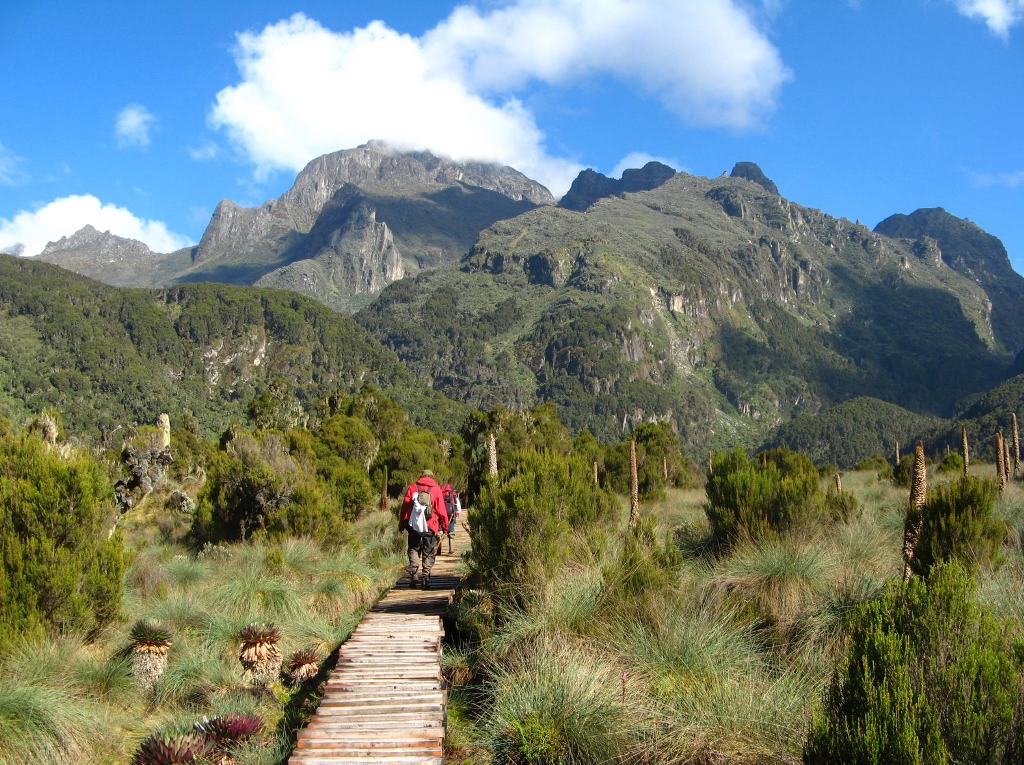
The Rwenzori’s distinguishing characteristic is its extraordinary Afro-alpine vegetation. Hikers traverse dark woodlands, profound marshes, and fog-laden inclines adorned with colossal heathers, big lobelias, and enormous groundsels, together evoking a remarkable, primordial ambiance.
The Rwenzori offers an authentic wilderness experience for trekkers, characterized by fewer fellow trekkers on the trails and the everyday challenges of mud, rain, and cold, culminating in the reward of traversing really difficult and glaciated landscapes.
The Rwenzori is the premier selection for seasoned climbers desiring not only the highest summit in Africa but also isolation inside a region of ecological marvel, as well as a comprehensive expedition experience beyond only ascending to the apex of the tallest peak.