The Wildlife of Kilimanjaro
The Wildlife of Kilimanjaro, You have to be very lucky to see much wildlife on Kilimanjaro. The more exotic fauna of East Africa occasionally ascends the mountain. Such occurrences are infrequent. Why? Because most animals prefer to be somewhere where there aren’t 50,000 people marching around every year.
So in all probability you will see virtually nothing of the animals on Kilimanjaro. During your expedition, you will encounter little more than the sporadic sighting of a monkey or mouse. However, remain silent and observant, and you may discover unexpected insights.
 Forest and cultivated zones
The animals on Kilimanjaro are more numerous down in the forest zone than anywhere else on the mountain. Regrettably, the concealment offered by trees and shrubs also persists, resulting in infrequent sightings.
As with the four-striped grass mice of Horombo (see below), it tends to be those few species for whom the arrival of man has been a boon rather than a curse that are the easiest to spot. The blue monkeys are observed daily in proximity to the Mandara Huts. Incidentally, these are not actually blue but grey or black with a white throat.
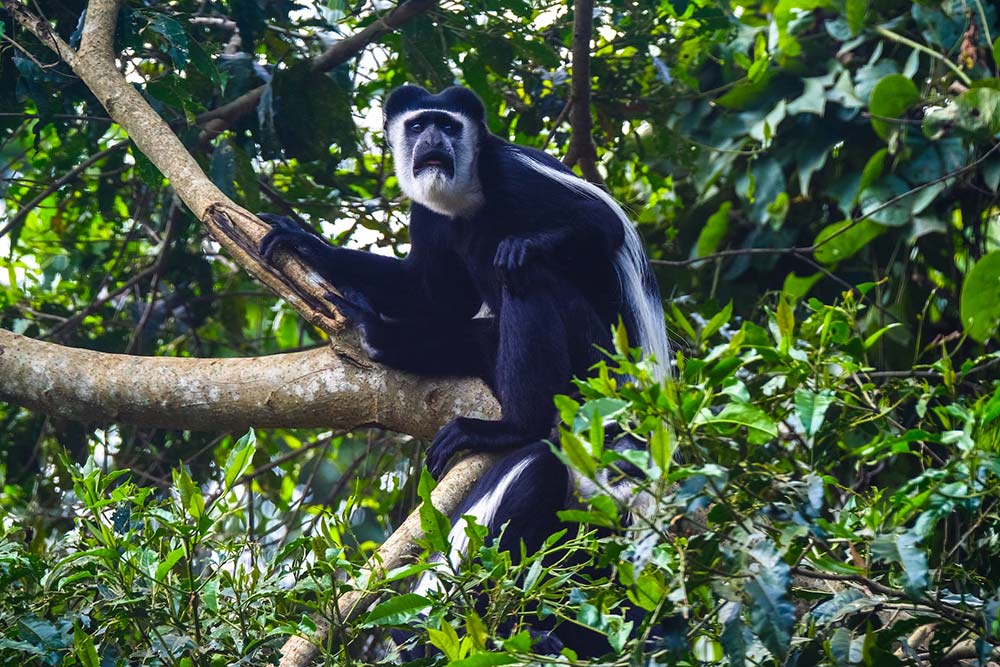
These, however, are simply the less ornate relatives of the exquisite colobus monkey. This organism possesses the most coveted tail in the animal realm. A troop of these can be observed in the beginning of the forest zone along the Rongai Route, near Londorossi Gate, as well as in proximity to the Mandara Huts.
Further down, near or just above the cultivated zone are the bushbabies. These are more easily heard than seen as they come out at night and jump on the roofs of the huts. Also present is the small-spotted genet, characterized by its characteristic black-and-white tail, alongside the vociferous, chipmunk-like tree hyrax.
Olive baboons, civets, leopards, mongooses and servals are said to live in the mountain’s forest as well. Nonetheless, sightings are exceedingly uncommon. The bush pig, characterized by a characteristic white stripe extending from its head to its tail, also inhabits this area.
 Animals you probably won’t see in Kilimanjaro’s forest
Next, there is the honey badger. Do not be deceived by the seemingly endearing name. Despite possessing a countenance that may only be appreciated by its progenitor, these are the most formidable and intrepid carnivores relative to their size in Africa. Even lions avoid them. You ought to as well. They can inflict significant harm upon you, and the prospect of informing your friends that, among all the ferocious beasts inhabiting the African plains, you were attacked by a badger is too humiliating to consider.
The creature is of comparable size. This elusive beast possesses colossal claws. In contrast to the honey badger, this nocturnal, elongated-snouted anteater is completely harmless. Therefore, do not be apprehensive: as the proverb states, an aardvark has never harmed anyone.
Aardvarks and honey badgers are seldom, if ever, observed on the mountain. Porcupines are not Africa’s largest rodents. Although present in this area, they exhibit shyness and nocturnal behavior. Your optimal opportunity to observe one is as roadkill en route to Dar es Salaam.
The rhinoceros is a creature that will certainly not be found at any altitude. A black rhinoceros was observed some decades ago on the northern slope of the mountain. However, it is now believed that excessive hunting has ultimately impacted this most magnificent of species. Count Teleki reportedly shot 89 of them during his tenure in East Africa, including four in a single day. Due of this behavior, none exist on or near Kilimanjaro today.
Heath, moorland, and elevated terrain
Similar to plant life, animal life too faces challenges in surviving at elevations beyond 2800 meters. Although visibility is limited, a few organisms inhabit the elevated regions of Kilimanjaro.
Above the treeline, visibility is often limited. The sole evident exception to this rule is the four-striped grass mouse (above). This small creature evidently does not perceive any difficulty in subsisting at high altitude. Indeed, if you are reading this at a camp, one is likely scurrying beneath your table at this moment. Additional rodents at this elevation are the harsh-furred mouse, the climbing mouse, and the mole rat. Nonetheless, all of these are somewhat more challenging to detect.
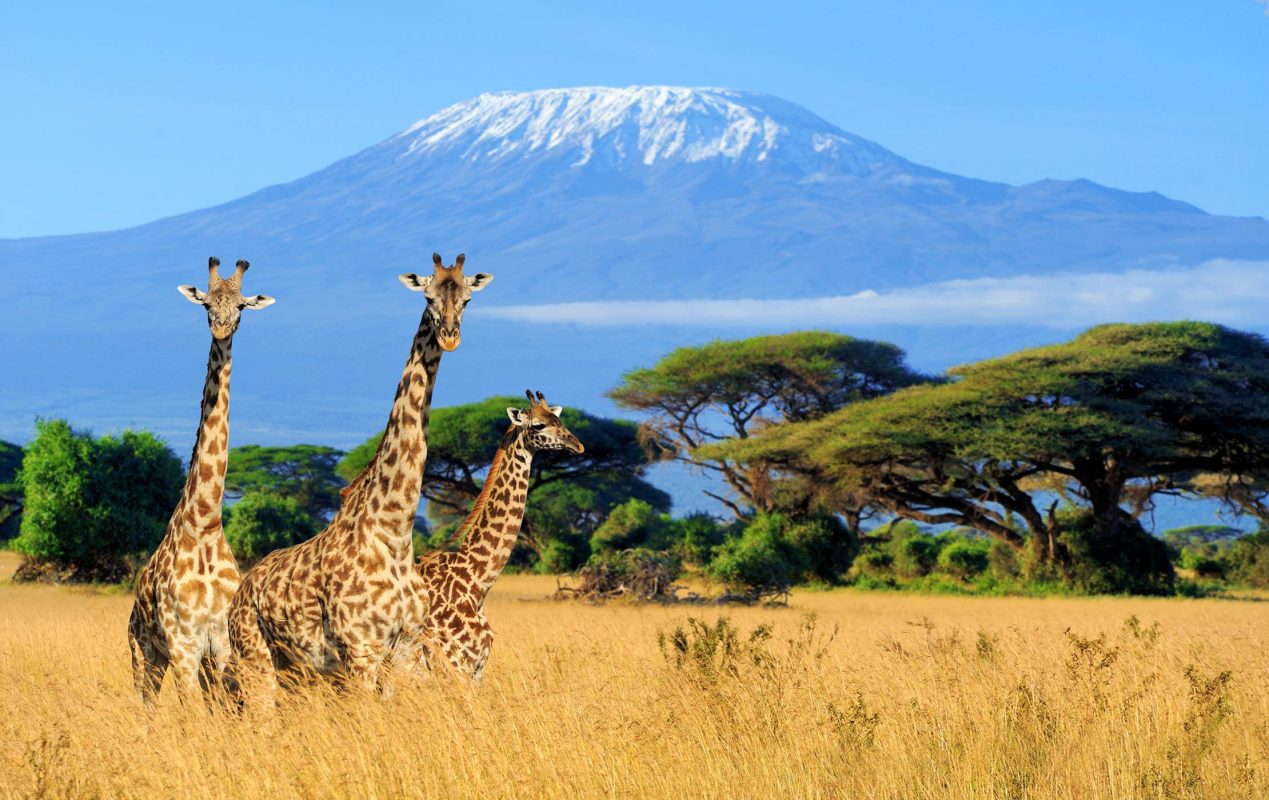
For any animal larger than a mouse, your optimal opportunity above 2800m is on the Shira Plateau. Lions are reported to roam here occasionally. The northern slope of the mountain along the Rongai Route is another favorable region for animals. Amboseli National Park in Kenya is situated at the base of the mountain, where various species occasionally ascend the slopes. The most common visitors are elephants, buffalo, and eland.
Should you see a ‘large’ animal on Kilimanjaro, it is likely to be a grey or red duiker, an eland, or a bushbuck. Nevertheless, sightings remain exceedingly uncommon. Indeed, one of these larger species resides continuously above the tree line of Kilimanjaro. Likewise, leopards, giraffes, and buffalo occasionally ascend the slopes. Indeed, they are, akin to us, but transient visitors.
The most exalted being of all!
Entomologist George Salt discovered a spider species inhabiting the alpine zone of Kibo at elevations reaching 5500 meters. The specific sustenance of these high-altitude arachnids is unidentified. Nonetheless, Salt himself believed it was likely the flies that arrived on the breeze. He discovered several of these flies that seemed either reluctant or incapable of flight. It is known that the spiders inhabit subterranean environments to evade the harshness of the weather.
Birdlife
Within the forest.
Kilimanjaro is renowned for its avian diversity. The agricultural lands on the lower slopes yield abundant food, the forested area offers refuge and numerous nesting locations, whereas the desolate upper slopes serve as optimal hunting territories for raptors.
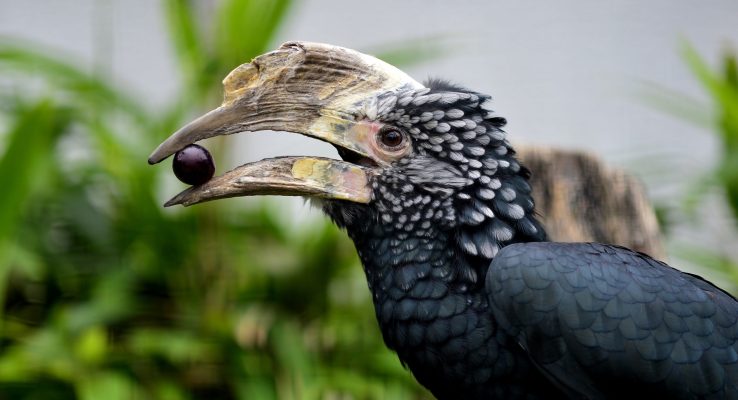
In the woodland, be vigilant for the boisterous dark green Hartlaub’s turaco. A nest was previously located near the initial lunch stop on the Machame Route. It is readily identifiable in flight due of its vivid crimson underwings. The silvery-cheeked hornbills and speckled mousebirds frequent the fruit trees in the woodland, especially the fig trees.
The trogon, characterized by its crimson belly, is challenging to observe due to its tendency to remain still among the branches.
Smaller avian species encompass the Ruppell’s robin chat, characterized by its black and white head, grey dorsal plumage, and orange ventral region, as well as the common bulbul, distinguished by its black crest and yellow under tail.
 In the camping areas
Higher on the slopes, the boisterous, foraging, talkative white-necked raven is a ubiquitous presence in the heath and moorland areas. Perpetually lingering in the air near the cottages and dining areas, it remains vigilant for any remnants of food. The alpine chat is smaller yet equally prevalent. This little brown avian possesses white lateral feathers in its tail. The streaky seed-eater, comparable in size, is another brown avian species characterized by streaks on its back, frequently found near campsites. The alpine swift thrives in these foggy, frigid conditions.
The most exquisite avian of all.
The award for the most exquisite avian specimen on the mountain is bestowed upon the resplendent scarlet-tufted malachite sunbird.
This charming bird, metallic green save for a little crimson patch on each side of its chest, floats above the grass, using its elongated mouth to extract nectar from the gigantic lobelias or to dine on them.
The velociraptors
Ascending further, we enter raptor territory. These birds are seldom observed at close range, as they predominantly glide on currents throughout the day in search of prey. The mountain and augur buzzards are frequently observed gliding above the Saddle.
These birds are remarkable, particularly if one has the fortune to observe them at close range. However, neither matches the size of the colossal crowned eagle or the uncommon lammergeyer. The latter is a large vulture characterized by elongated wings and a wedge-shaped tail. A backdrop is visible behind the header at the top of this page.